
Ouch MahjongA beginner’s guide
Your First American Mahjong Game
A friendly guide from the first tile to the final call.
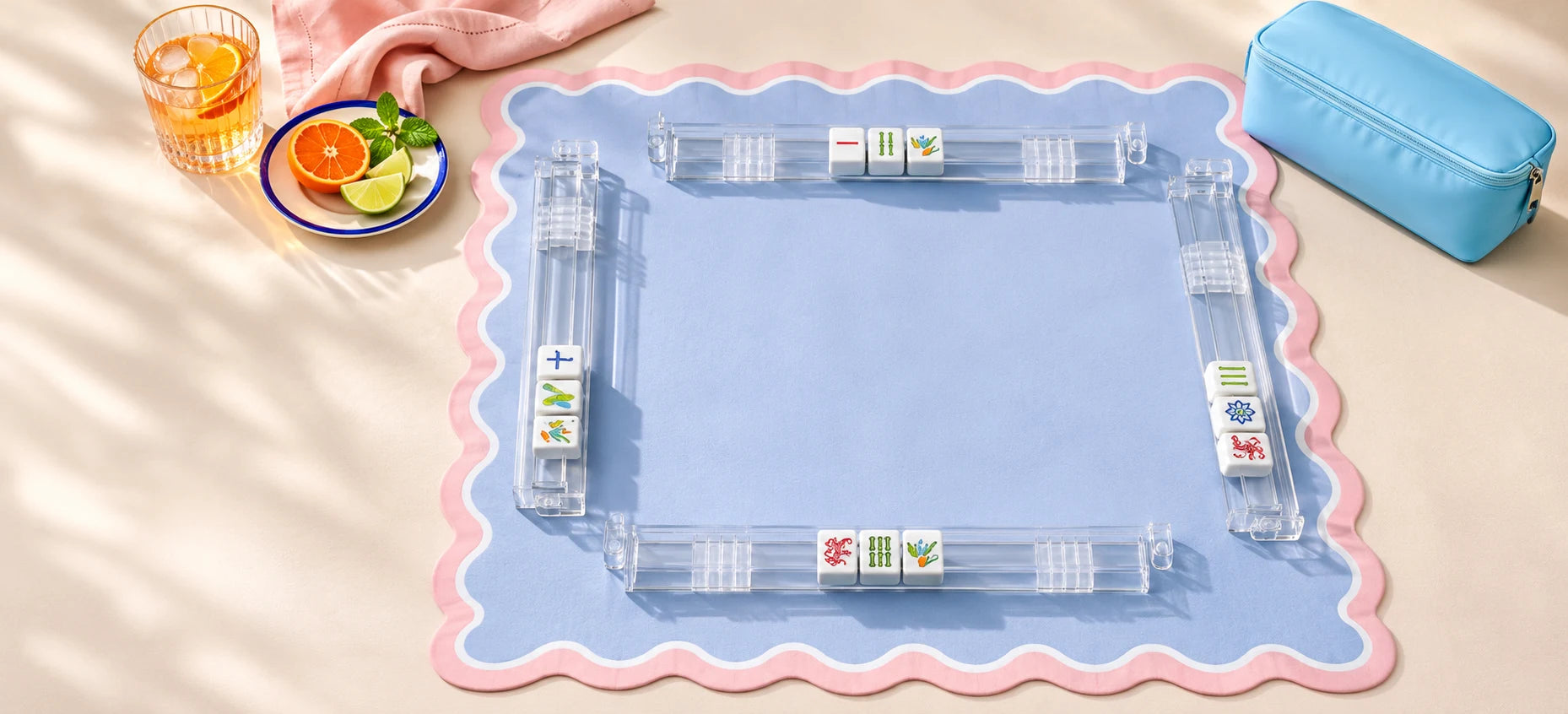
AI-styled accessory scene. Tiles and tableware are props.
Your first game starts here. Turn the pages for the tiles, the Charleston and the rules to know before you play.
A friendly guide from the first tile to the final call.
AI-styled accessory scene. Tiles and tableware are props.
Read in order, or choose the rule you want to understand.
Start by sorting the tiles into familiar families.
A standard American mahjong game uses 152 tiles. Dots, bams, and craks are the three numbered suits. Each runs from one through nine, with four copies of every tile.
There are also four copies of each wind and each dragon. White dragons are often called soaps. The eight flower tiles are interchangeable, even when their pictures differ.
Learn the tile names before chasing a winning hand.
Your goal is a complete hand allowed by the current annual card.
Each player needs the same year’s NMJL card. Read the whole line, including its notes. Colors show suit relationships, not fixed assignments to dots, bams, or craks. Matching colors generally mean matching suits. Different colors mean different suits.
Flowers and winds are exceptions to that color shortcut. Follow the card’s notes for dragons and special requirements.
Keep your own current card beside your rack.
Four players sit around the table, each with a rack.
Shuffle the tiles face down. Each player builds a wall 19 stacks long and two tiles high. Choose East, the starting player, and use the dice to break the wall.
Follow the dealing sequence with an experienced player your first time. East begins with 14 tiles. Everyone else has 13. Keep your tiles facing you, then look for possible hands on the card before passing begins.
Count your tiles before the Charleston starts.
The Charleston gives everyone a chance to improve their starting tiles.
Pass three tiles right, then across, then left. This first round is required unless East already has a winning hand before passing begins. Never pass a joker.
A second round goes left, across, then right. Any player may stop it after the first round without explaining why. Speak up before anyone picks up and looks at the second-left pass. Once the second round starts, finish all three passes.
Pause after the first round so everyone can decide.
Some passes let you keep more of the tiles you want.
On the first round’s final left pass and the second round’s final right pass, you may forward up to three incoming tiles without looking at them. This is a blind pass. Your outgoing pass still totals three tiles.
After either completed round, opposite players may make a courtesy pass of zero to three tiles. Exchange the smaller number requested. Someone who stopped the second round may still participate.
Blind means unseen. A courtesy pass is optional.
East starts by discarding one tile without drawing.
Then play moves to the right, counterclockwise. On a regular turn, draw the next tile from the active wall, consider your options, and discard one tile face up. Say its name clearly. Unless someone wins or makes a legal call, the next player takes a turn.
Keep 13 tiles between turns, counting any tiles exposed on your rack. Drawing brings you to 14 before your discard. Avoid reaching for a tile before your turn.
Watch the table as carefully as your own rack.
A useful discard can interrupt the usual turn order.
Say “call” for the latest discard to complete a permitted group of three or more matching tiles. Display the completed group on top of your rack, then discard. Play continues to your right.
You cannot call for a single, pair, or C hand unless that tile completes mahjong. Call promptly. Racking the next draw closes the usual calling window, and other actions can close it sooner. Check official rules for timing disputes.
An X hand permits exposures. A C hand stays concealed until the win.
Jokers are flexible, but their limits matter.
A joker can replace a tile in a group of three or more identical tiles, including a pung, kong, or quint. It cannot replace a single tile or either tile of a pair, even when that would complete your hand.
A printed group of different tiles is still a collection of singles. Concealed hands may use jokers in eligible groups. You may not call a discarded joker, even to win.
Check the group itself before using a joker.
An exposed joker may become useful to you on your turn.
After drawing, or completing a legal called exposure, you may exchange the exact tile a joker represents for that joker in a valid exposure. This can be your exposure or another player’s. Make the exchange before discarding.
If you call a discard, you must already be able to complete that exposure without the exchange. You cannot take a discard just to redeem a joker. Announce the exchange and ask the other player to hand you their joker.
Draw or complete your call first. Exchange next.
When your 14 tiles satisfy a card hand, announce “mahjong.”
Show the whole hand so everyone can check its groups, suits, and notes. If the wall runs out without a winner, the hand ends as a wall game. Use the current official rules for scoring and unusual situations.
Keep comments about unfinished hands to yourself, respect passing decisions, and give new players room to learn. For a comfortable setup, leave space between your rack, card holder, and the discard area.
A clear table and considerate players make learning easier.
The League publishes the annual card and official rulebook. Independent teaching sources help explain the basics.
Reviewed November 16, 2026. Follow the current card, rulebook and rules agreed at your table.
These independent teachers explain specific rules and common questions.
Reviewed November 16, 2026. Follow the current card, rulebook and rules agreed at your table.
An introduction to four-player, NMJL-style American mahjong. Use your own current National Mah Jongg League card and official rulebook for complete rules. House and tournament rules may differ. Independently prepared by Ouch Mahjong.